
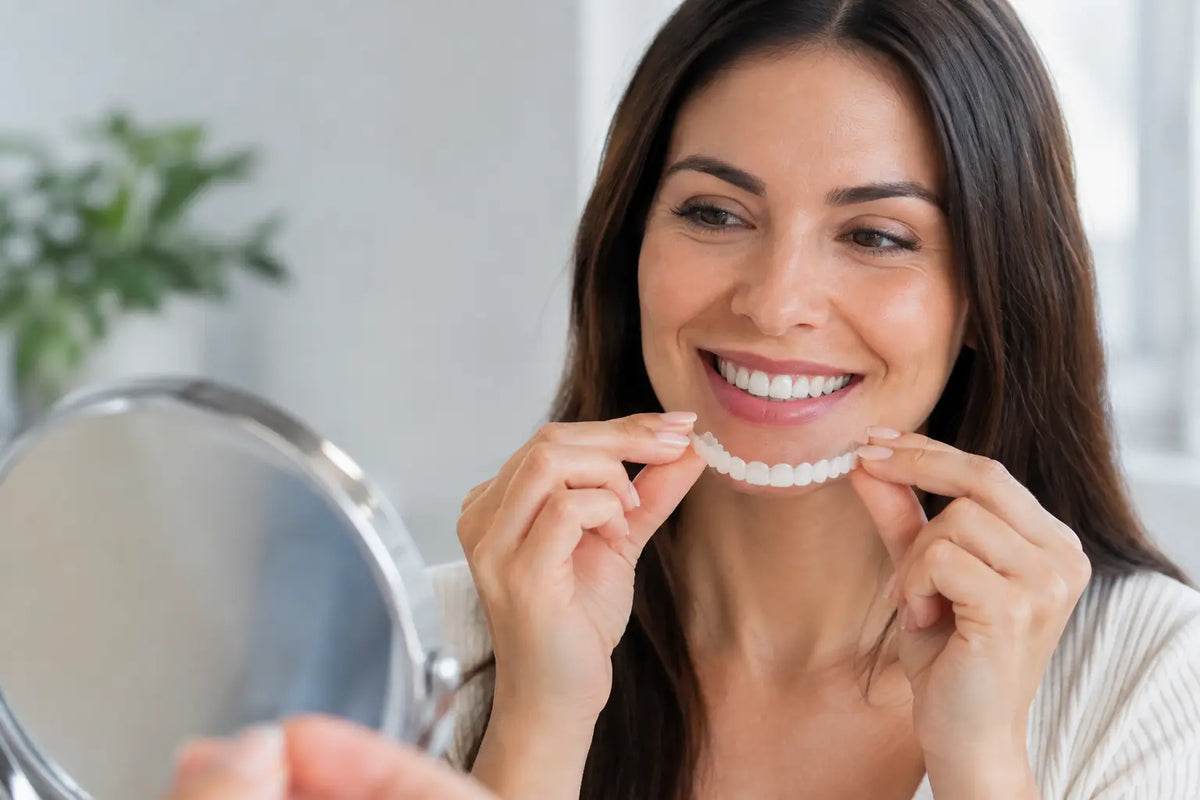
Your new removable veneers should feel like they were made for your smile, not like something you have to fight to wear. Knowing how to check veneer fit gives you a clearer first-wear experience and helps you recognize the difference between a normal adjustment period and a fit concern that deserves support.
A custom removable veneer is designed around your submitted impressions. It should sit securely over your natural teeth, look balanced from the front, and feel comfortable enough for normal conversation. It should never require painful force, repeated bending, or DIY trimming to make it work.
Start With a Clean, Careful First Try-On
Before trying in your veneer, rinse it with cool or lukewarm water. Avoid hot water, which can affect the shape of a removable dental appliance. Stand in front of a well-lit mirror, preferably with a clean towel over the counter or sink in case the veneer slips from your hands.
Hold the veneer by its sides rather than pressing hard on the front teeth. For an upper veneer, line it up with your upper teeth and gently press it into place from the front toward the back. For a lower veneer, position it over the lower teeth and apply even, gentle pressure until it is seated.
Do not bite down forcefully to push it into place. A custom veneer should settle with controlled pressure. If it will not seat fully, feels sharply painful, or appears noticeably crooked, remove it rather than forcing it further.
Give Yourself a Few Minutes to Assess It
The first few moments can feel unfamiliar, especially if you have not worn a cosmetic dental appliance before. Your lips and tongue may notice the added contour, and certain sounds may feel different at first. That initial awareness is not automatically a sign of poor fit.
What matters is whether the feeling improves as you relax and whether the veneer rests comfortably in place. You should not experience pinching, stabbing pressure, or a sensation that one area is being forced far more than another.
How to Check Veneer Fit in Five Key Areas
A proper fit involves more than checking whether the veneer stays on. Look at comfort, seating, retention, your bite, and the overall appearance of your smile.
1. Check That the Veneer Is Fully Seated
Look closely in the mirror at the gumline and along the edges of the appliance. A well-seated removable veneer should sit evenly over the visible teeth without an obvious lifted section on one side. The left and right sides should appear balanced rather than tilted.
Some natural teeth have different shapes, angles, or spacing, so the edge will not look identical at every point. The goal is a natural, even placement that follows your smile, not a perfectly straight line that looks artificial.
If one side consistently pops up or will not seat while the other side fits, stop wearing it and contact your support team. This can happen when an impression needs to be reviewed or when an adjustment is required.
2. Test for Secure, Gentle Retention
Once seated, gently move your lips, smile, and speak a few full sentences. Your veneer should remain in place during normal facial movement. It should not feel like it is sliding around, falling forward, or ready to come loose each time you talk.
At the same time, secure does not mean painfully tight. A veneer that feels locked in with severe pressure is not something to ignore. You should be able to remove it carefully using gentle, even pressure, without pulling aggressively or twisting the appliance.
Retention can vary based on the shape and position of your existing teeth. This is exactly why a custom impression process matters more than a one-size-fits-all cosmetic product.
3. Notice Any Pressure Points
Run your tongue gently around the inside edge of the veneer. Then pay attention to how your gums, lips, and cheeks feel after wearing it for a short period. Mild awareness of a new appliance can be normal. Localized pain is not.
A pressure point may feel like a sharp edge, a single spot that digs into the gumline, or soreness that becomes more noticeable the longer you wear the veneer. Remove the appliance if that happens. Do not try to file, cut, heat, or reshape it at home. Small changes can affect comfort, retention, appearance, and the strength of the material.
Photos can be useful when requesting help. Take a clear front-facing photo while smiling, plus a close-up of the area that looks lifted, uneven, or uncomfortable. This gives a design consultant or dental professional a better starting point when reviewing your concern.
4. Check Your Bite Without Forcing It
Close your mouth slowly and naturally. Your upper and lower teeth should come together without the veneer creating a painful collision or preventing you from closing comfortably.
If you ordered an upper veneer only, you may notice your bite differently because the appliance adds a cosmetic layer over the front of your teeth. The same can be true with a lower veneer. The question is whether your bite feels generally natural and manageable, not whether it feels exactly the same as it did without the appliance.
Do not repeatedly clench or grind to test the fit. Removable veneers are cosmetic appliances and should be worn according to the instructions provided with your order. If closing your teeth creates significant pressure, instability, or discomfort, remove the veneer and ask for guidance before continuing to wear it.
5. Look at the Smile From More Than One Angle
A flattering fit should improve the harmony of your smile while still looking like it belongs on your face. Check your reflection straight on, then turn slightly to each side. Look for an even smile line, a natural relationship with your lips, and a shade that works well in normal lighting.
Take a photo with your phone camera, too. A mirror can be helpful, but photos often reveal whether the veneer looks balanced when you are speaking, smiling, or posing the way you would in everyday life.
Custom removable veneers are intended to improve the visible concerns that may be making you hold back, such as staining, chips, gaps, uneven edges, or missing visible teeth. They should not look bulky, crooked, or disproportionately long. If the look does not match the approved design expectations, ask for a review rather than trying to adapt to a result you do not feel confident wearing.
What Is Normal and What Needs Attention?
A new removable veneer can take a little getting used to. Slight changes in speech, extra awareness of the appliance, or a brief period of learning the best placement technique are common. Many people find that reading aloud for a few minutes helps their speech feel more natural.
Fit concerns are different. Remove the veneer and seek personalized support if you notice ongoing pain, gum irritation, a sharp edge, repeated loosening, an inability to seat it fully, major bite interference, or visible warping or cracking. Do not continue wearing an appliance that feels wrong in a way that does not improve.
It also helps to keep expectations realistic. A removable veneer can create a meaningful cosmetic change without drilling, needles, or permanent alteration to your natural teeth. It is not the same as a permanently bonded veneer, and its comfort and performance depend on accurate impressions, careful production, proper placement, and following wear guidance.
If the Fit Is Not Right, Do Not Guess
The most helpful next step is to describe the issue clearly. Note whether the concern is on the upper or lower veneer, which side is affected, whether it happens during seating or while speaking, and how long you have worn it. Clear photos and a short explanation are often more useful than simply saying it feels "off."
At Removable Veneers USA, every custom order is supported by a personal design consultant and produced through a U.S.-based dental lab process. That support matters because a fit question is not something you should have to solve alone with internet advice or at-home modifications.
Your impressions are the foundation of the final appliance. If you are still in the impression stage, take your time and follow each instruction closely. A detailed, accurate impression gives the production team the information needed to create a veneer that follows your unique teeth and smile shape.
A great fit should let your attention move away from the appliance and back to the moments you want to enjoy. If your veneer feels secure, comfortable, and natural-looking, wear your new smile with confidence. If it does not, pause and get the personalized help you deserve before moving forward.